



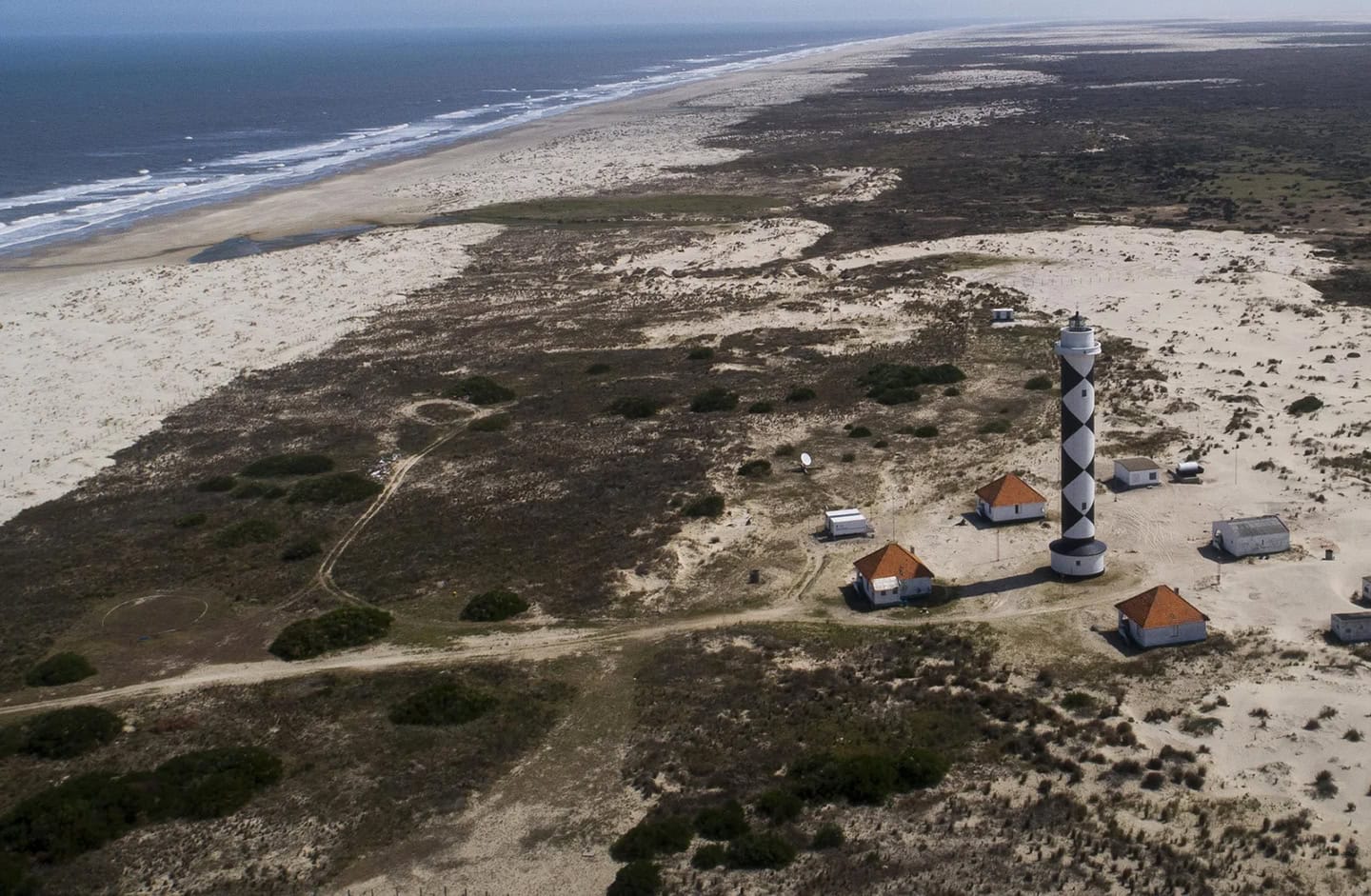
In Brazil’s far south, the arrival of spring along the vast stretch of sand between Praia do Cassino and Barra do Chuí, in the state of Rio Grande do Sul, was once associated with death.
At that time of year, the rough, churning sea would surge onto the shore, washing up hundreds of dead franciscana dolphins (Pontoporia blainvillei), also known as toninhas in Brazil – a small dolphin species with a slender body and a rounded snout that inhabits the South Atlantic.
The bodies piled up on the sand were victims of so-called “bycatch,” the unintentional capture of non-target species. The franciscana dolphins and other marine animals died after becoming entangled in the nets of fishermen targeting corvinas, which are abundant in the area during this period.
To address this marine mortality, the Brazilian government established Albardão National Park in March this year. The predominantly marine protected area prohibits extractive activities, including fishing.
Eight months later, signs of change are beginning to emerge, according to reports from hikers, local residents, and military personnel.
A trail of carcasses
Few people encountered animal carcasses along the coast of Rio Grande do Sul between spring and summer. Much of the nearly 250-kilometer stretch between Praia do Cassino and Barra do Chuí is remote and inhospitable, with no homes, support facilities, or cell phone coverage.
One of the adventurers who regularly travels this stretch of coastline is Fernando Souza Neto, owner of the company Caminho dos Faróis. For the past 13 years, he has been organizing beach treks for groups of 16 people. The itinerary offers days of seclusion and a deeper connection with nature. Many hikers, however, have been unsettled by the sight of carcasses scattered along the shore.
“I’ve heard people say they never imagined they’d have to walk through death. We’ve even counted 52 dead franciscana dolphins between the Sarita Lighthouse and the Albardão Lighthouse. It’s heartbreaking,” the guide says.
In October this year, Souza Neto completed the trek without encountering a single carcass.
“For the first time, I didn’t come across a single dead franciscana dolphin during my seven-day hike. I believe this change is a result of the national park’s creation,” he said.
The same is true of Alexandro de Oliveira, a guard at the Albardão Lighthouse, who is now serving his second consecutive year there. Each deployment involves two Navy personnel and lasts between 70 and 75 days, until the next rotation.
Oliveira says that, in 2025, he frequently came across dead animals during his routine beach patrols.
“There used to be 10 to 15 carcasses within a 10-kilometer radius: franciscana dolphins, sea lions, and turtles. On my latest visit, however, I saw only one dead animal – a turtle. It’s also been quite a while since anyone spotted any boats in the area. Last year, the sea was teeming with them, even at night,” the ranger says.
Agência Brasil spent a week in the region in October and also observed signs of a possible environmental shift. Along approximately 70 km of coastline, the team did not spot a single dead franciscana dolphin.
There were six dead sea lions, most likely from natural causes, according to Danielle Monteiro, a researcher at the Responsible Fisheries Laboratory of the Federal University of Rio Grande (FURG).
Tagging and genetic studies have shown that the stranding of pups from colonies in neighboring Argentina and Uruguay is common and is associated with their search for food, she explains.
The team also spotted five live sea lions resting peacefully on the sand.
Danielle Monteiro adds that FURG researchers had found only one dead franciscana dolphin (pictured below) during the week the reporter visited the area, and that it had washed up on a different beach.
These isolated observations do not provide sufficient scientific evidence to conclude that animal populations are already recovering. Experts say that at least three years of continuous monitoring are needed to statistically assess changes in stranding rates, determine whether they are linked to the establishment of the park, and account for environmental and climatic variations.
Marine conservation experts had been calling for the creation of the national park for more than 20 years.
Albardão
Albardão National Park was established by presidential decree in March 2026, encompassing 1,004,480 hectares (approximately 10,045 km²) along the coast of the municipality of Santa Vitória do Palmar.
Although a small strip of sandy coastline lies within the protected area, most of the conservation unit is marine.
In general, strictly protected areas such as Albardão prohibit activities involving the extraction of natural resources or causing damage to the environment. Other activities, including scientific research, public visitation, environmental education, and ecotourism, are subject to regulation.
An environmental protection area, spanning 55,983 hectares (approximately 560 km²), and a buffer zone, covering 558,025 hectares (approximately 5,580 km²), were also established. Both may accommodate economic activities in the future, although the specific activities permitted and the rules governing them have yet to be defined.
Sea without borders
Encouraged by the establishment of Albardão National Park, researchers at the Institute of Ocean Sciences of the University of the Republic of Uruguay (UDELAR) hope to extend marine protection into Uruguayan waters.
Valentina Franco-Trecu, a Ph.D. ecologist and professor, said the group had submitted a technical proposal outlining the request to Uruguay’s Ministry of the Environment.
“We envision a continuous protected area extending from Chuí into Albardão. It would be the dream of genuine cross-border conservation, with two countries working together to protect the same marine ecosystem,” Franco-Trecu says.
The researcher has been studying marine mammals – including franciscana dolphins, sea lions, and fur seals – for 24 years. She advocates extending the network of coastal protected areas to include sites in Uruguay, such as Cerro Verde, Cabo Polonio, Laguna de Rocha, and Laguna de Castillos.
“This entire area connecting Brazil and Uruguay is extremely rich in biodiversity. It encompasses a wide variety of coastal environments, including wetlands, sandbanks, and intertidal zones. Establishing ecological continuity would therefore make conservation efforts much more effective,” she concludes.
Source: Agência Brasil