



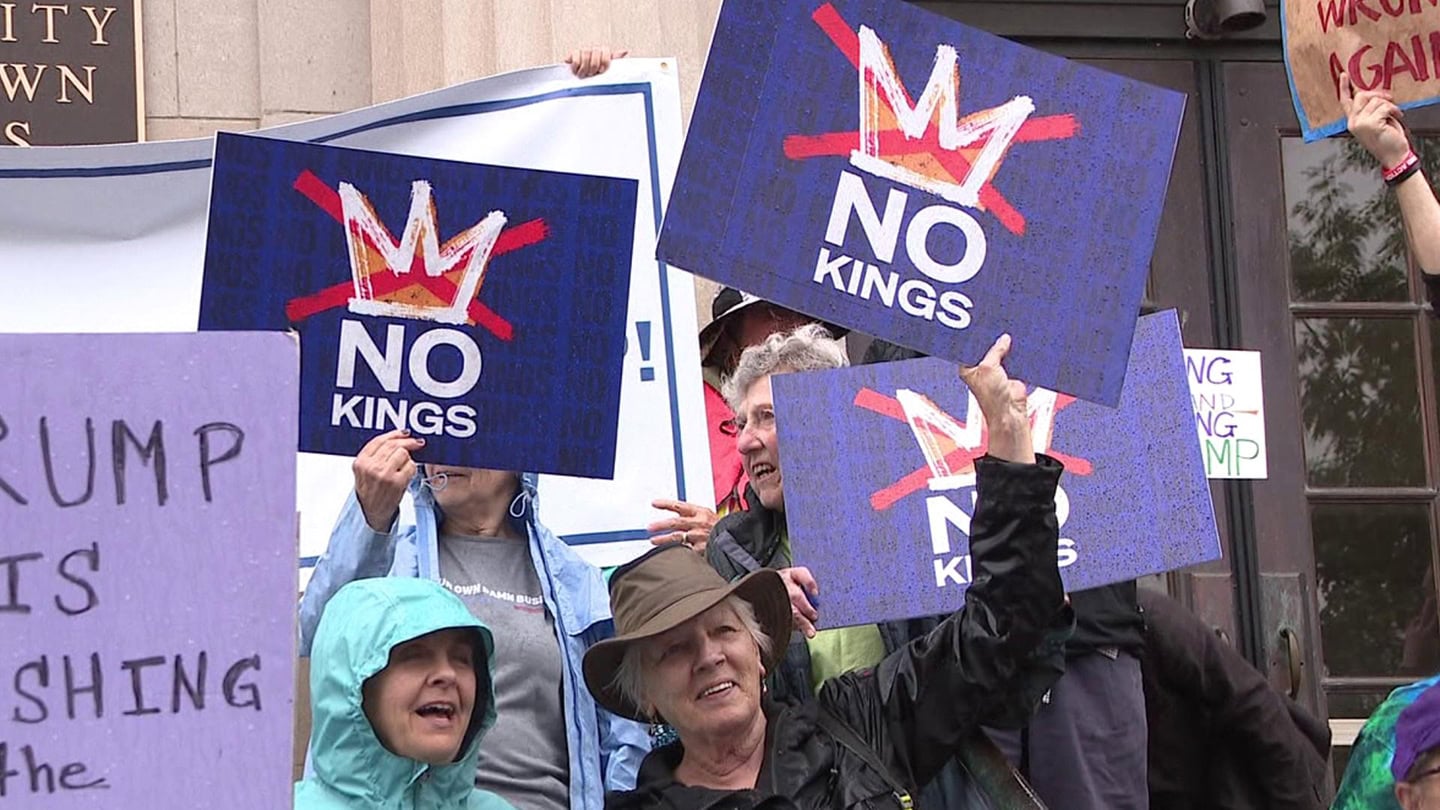
No Kings protests rippled peacefully across dozens of cities, both in the U.S. and overseas, to stand against the Trump administration’s large-scale military parade on Saturday (14). But they came against the backdrop of apparent political violence in Minnesota, where a state lawmaker was killed in her home.
Organizers estimated that more than 5 million people participated in more 2,000 planned protests, according to spokesperson Eunic Ortiz. Events were also held in Germany and France, according to the AP. While protests were peaceful, police in Culpeper, Va., arrested a man who “intentionally accelerated his vehicle into the dispersing crowd,” at the end of a protest. One person was hit, but no one was hurt, police said.
Organizers are accusing the president of putting on the military parade as a show of dominance and a celebration of his 79th birthday, which is also on Saturday. The Army has been planning some form of anniversary celebration for over a year, but the parade was a recent addition. It will commemorate the 250th anniversary of the U.S. Army, and falls on Flag Day. A peacetime military parade is rare in the U.S. and has drawn criticism from Trump’s political rivals.
Tens of thousands marched peacefully in Philadelphia, where organizers were holding their main event, police said. Philadelphia was chosen as the hub, because “there’s an indelible link between Philadelphia and between the freedoms and the ideals that the country was founded upon,” said Joel Payne, spokesman for MoveOn, one of the dozens of groups behind the No Kings protests.
Ezra Levin, co-founder and co-executive director of the non-profit Indivisible, another No Kings coordinator, said the atmosphere at the event was joyful. “Today what I saw was a boisterous, peaceful display of First Amendment rights,” he told NPR.
Protests carried on in Minnesota, despite organizers calling for the cancellation of all events in the state. “This decision comes in light of the ongoing shelter-in-place order and the tragic shooting that targeted two elected officials and their spouses,” No Kings said in a press release. Despite the warnings, tens of thousands showed up for a protest at the Capitol, Minnesota State Patrol spokesman Lt. Mike Lee told MPR News.
Thousands were at a Dallas protest, one of more than 60 planned in Texas, KERA reported. In Alaska, the theme was, “The only king I want is king salmon,” Alaska Public Media reported.
There were some feelings of unease amid the protesters, some of whom turned off their phones and avoided posting to social media.
“It does feel like there’s a vendetta against people who are exercising their rights to speak up against this administration,” said protester Ali Schoenberger of Sacramento. “So I feel like it’s important to protect my fellow protestors today and not expose them or even have it on my phone.”
Despite a forecast high of 106 degrees in Green Valley, Ariz., a few hundred people turned up, said Martha Jane Gipson, a retired school teacher.
Trump on Thursday was asked about the protests, and told reporters, “I don’t feel like a king. I have to go through hell to get stuff approved.”
Separately, U.S. Capitol Police said they arrested 60 protesters Friday evening after some pushed down barriers and ran toward the steps of the Rotunda. They say all 60 will be charged with unlawful demonstration and crossing a police line. Additional charges include assault on a police officer and resisting arrest. The groups behind the protests didn’t immediately respond to requests for comment.
The No Kings demonstrations were put together by a coalition of more than 200 organizations, including MoveOn, the American Civil Liberties Union, American Federation of Teachers and the Communications Workers of America. Protests were not planned in Washington, D.C., where the military parade was held.
According to the organizers’ website, the protesters were avoiding the nation’s capital “to draw a clear contrast between our people-powered movement and the costly, wasteful, and un-American birthday parade in Washington.”
Source: npr.org By Clare Marie Schneider, Ayana Archie