



A study conducted by researchers at Peking University has reignited the scientific debate about the behavior of the Earth’s inner core. According to a report by CNN Brazil , the research suggests that the rotation of this deep layer of the planet may have slowed significantly in the last decade and may even have begun moving in the opposite direction to what had been occurring previously.
The investigation was conducted by scientists Yi Yang and Xiaodong Song , who analyzed seismic waves generated by earthquakes since the 1960s. These waves travel through the Earth’s interior and allow researchers to infer changes in the rotation speed of the inner core.
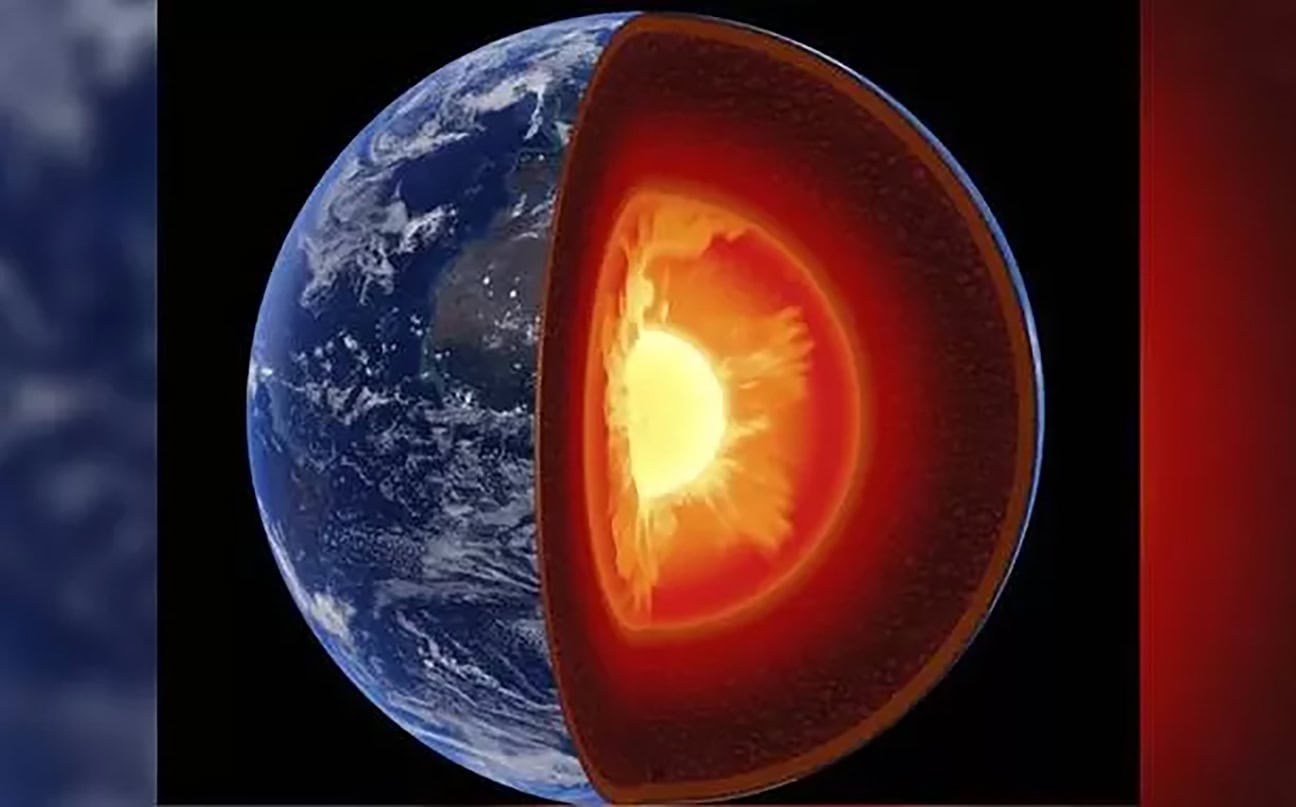
The Earth is made up of different layers: crust, mantle, outer core, and inner core. The latter is solid and is located about 5,100 kilometers below the Earth’s surface. It is surrounded by a liquid outer core, which allows it to rotate independently of the rest of the planet.
With a radius of about 3,500 kilometers—similar in size to the planet Mars —the Earth’s core is composed mainly of iron and nickel and concentrates approximately one-third of the planet’s total mass.
According to the study, seismic observations indicate that something unusual occurred starting in 2009. Until then, seismic wave records showed perceptible changes over time, suggesting variations in the rotation of the inner core. However, in the following years, the differences practically disappeared.
The researchers explained the discovery in a scientific article. “We show surprising observations indicating that the inner core has almost ceased its rotation in the last decade and may be undergoing a reversal,” they wrote.
Song also highlighted the change observed in the data over the decades. “When you look at the decade between 1980 and 1990, you see a clear change, but when you look from 2010 to 2020, you don’t see much change,” the researcher stated.
According to scientists, the movement of the inner core is influenced by complex forces within the planet. Rotation is primarily driven by the magnetic field generated in the liquid outer core, while gravitational forces from the mantle act as a balancing factor. The interaction between these forces can cause small variations in the rotational speed over time.
The study’s authors suggest that the observed slowdown may be part of a natural cycle that occurs approximately every seven decades. According to their calculations, a similar change would have occurred in the early 1970s.
Other experts, however, urge caution in interpreting the results. Geophysicist Hrvoje Tkalcic , who did not participate in the research, evaluated the data but stressed that the phenomenon does not represent any immediate risk to the planet.
“The inner core doesn’t stop completely,” the scientist explained. According to him, the results indicate only a relative change in rotation speed compared to the rest of the Earth.
He also stressed that there is no reason for alarm. “Nothing cataclysmic is happening,” he added.
Despite the advances, the authors themselves acknowledge that many questions remain unanswered about the workings of the Earth’s interior. Therefore, new studies and analytical methods will be needed to better understand the behavior of the inner core and its influence on the planet’s dynamics.
Source: brasil247.com