



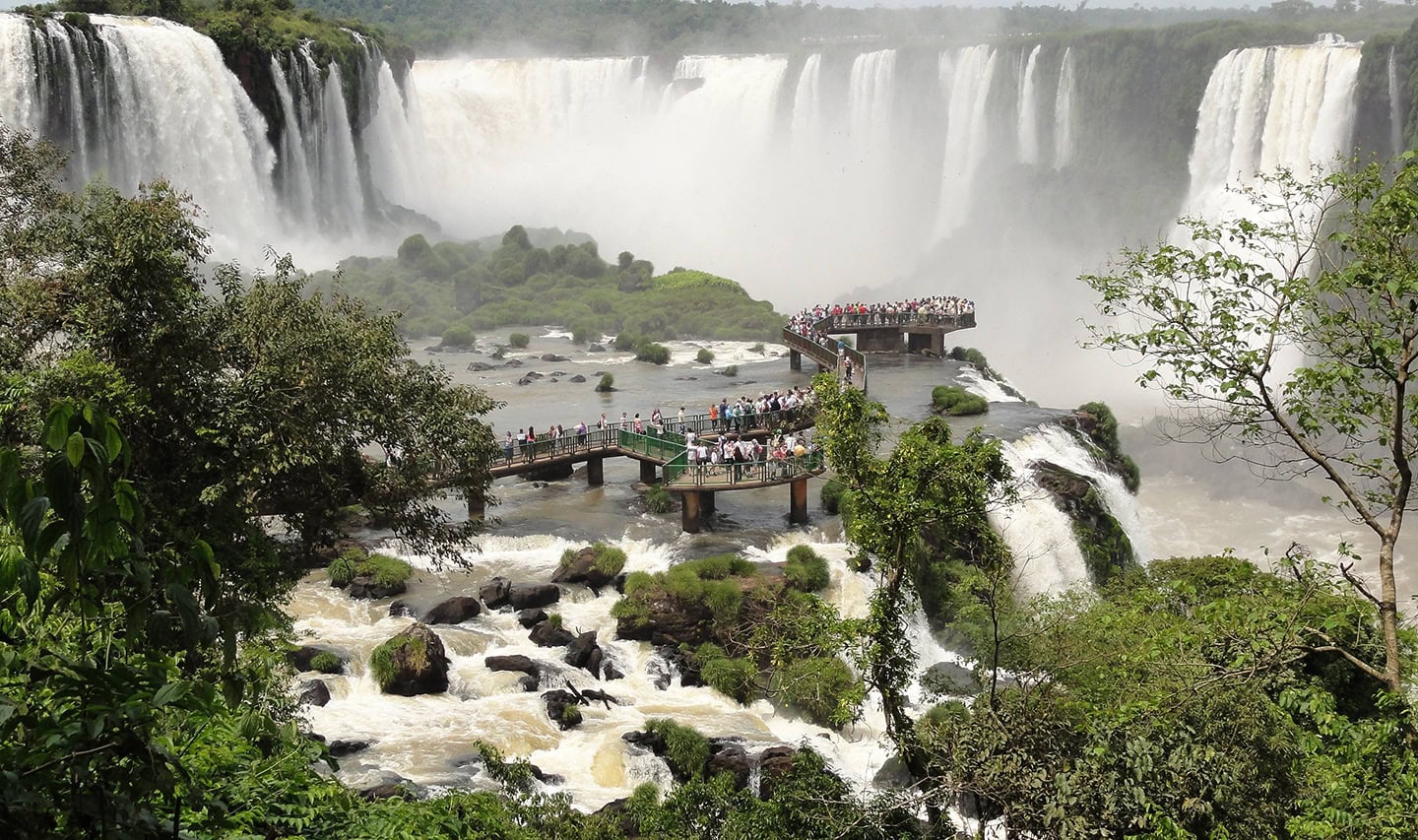
“My poor Niagara …” That is what Eleonor Roosevelt said when she saw Iguaçú Falls.
The Iguaçú Falls consists of two national parks, one in Foz do Iguaçú (Brazil) and the other one in Puerto Iguazu (Argentina). The curious thing is that although one only sees the falls as the main attraction, the park has a size of 252,982 hectares (67,720 on the Argentine side and 185, 262 on the Brazilian side).
These falls in Argentina and Brazil managed to attract so much attention that almost at the same time they were declared National Parks (1934 in Argentina and 1939 in Brazil). And after some years and millions of visitors fascinated by the landscape and the sound of this natural attraction, UNESCO declared them as World Heritage Site in 1984, and reaffirmed as Exceptional Universal Value (their cultural and nature it’s so important that it’s conservation should be of worldwide interest) in 2013.
Why are they so famous? It is enough to just see photos and videos to be amazed by its beauty. But it is not only about tourism: the Iguaçú National Park is home to many species of animals and flora that create an important natural ecosystem connected to all Latin America.
History of Iguaçú Falls
The Iguaçú National Park, shared between Brazil and Argentina, is one of the main attraction, not only touristically, but also ecological and natural.
But before this place was what we know nowadays, it had a curious story.
The origin of the name Iguaçú comes from the Mbyá-Guaraní indigenous people, who in the translation into our Spanish, would remain as “Água Grande”. The reason for the name is self-explanatory.
The first person who found Iguaçú Falls was a Spanish explorer named Alvar Nuñez Cabeza de Vaca, who during a journey from what we now know as Asunción (Paraguay) would encounter the falls, which he would call “Saltos del Santa Mary”.
 Later, the first Jesuit missions arrived (today its ruins are an interesting tourist attraction), which made up more than 30 towns distributed in southern Paraguay, Brazil, and the entire province of Misiones. After this, by 1768, the Jesuits would be expelled by the Crown of Spain, and the place would be forgotten.
Some time later, Gregorio Lezama, an Argentine businessman and politician, would sell the land because he considered it of low value. In the auction it appeared as “a block of jungle that borders several waterfalls”.
These lands would be acquired by Domingo Ayarragaray in 1907, who would discover the tourist potential of the place, setting up the first hotel and setting up some roads for people to get to know the falls.
It is interesting to mention that, in 1901, the first tourist excursion to the area arrived, but without positive results since it was difficult to cross the place. One of the participants in this group was Victoria Aguirre, who thanks to their donation together with Gibaja and Nuñez, allowed them to build the first highway from Puerto Iguazu (Misiones, Argentina) to Iguaçú Falls.
And in 1934, Law 12,103 would allow the creation of the “Iguaçú National Park”. Giving entity -especially legal- to this natural spectacle.
In 1984, UNESCO declared the Iguaçú National Park as “World Heritage”. In 2011, the New Seven Wonders Foundation declared it “New Wonder of the World”. And finally, in 2013, UNESCO again declared the Iguaçú National Park as “Exceptional Universal Value”, due to the cultural and natural importance of this area.
Wildlife in Iguaçú Falls
Iguaçú Falls is the home of a great variety of animal life that cannot be found anywhere else.
On your visit to both national parks, it is very easy to find coaties, an small four-legged and long-tailed animals that roam the area in search of food that visitors usually give them (for safety reasons, they are asked NOT to feed them).
Another animal that you will easily see is the toucan. It is generally easier to see it in some tress on the Devil’s Throat circuit.
In addition to the toucan, there are many bird species that you can see throughout the tour. If you are interested in bird  watching and want to do it during your visit, do not hesitate to see our Birdwatching tour in Iguazu.
Although a little more difficult, another animal that can be seen is the monkey caí, small animals that hang around the park in a group. In the same way, they approach tourists in the hope of obtaining a snack, but you should not give them any food.
Other animals present in the area, but not possible to see in the park is the yaguareté, a feline that is currently in danger of extinction. Naturally it is difficult to see it in the park since they always get away from people.
The tapir is another animal that can also be seen in this area. This animal is one of the largest mammals in Latin America, although it is quite difficult to locate it. If you are interested, there is a tour to see tapirs at night in the Uruguay-i provincial park.
If you are interested in seeing these animals and other species more closely and in detail, you can go to zoos such as the Bird Park in Foz de Iguaçú, or Guira Oga in Puerto Iguazu. The mission of these two places is to recover animals injured on the routes or rescued from animal trafficking, to heal them and then reintroduce them to their habitat. The animals that can be seen in these places are those that can no longer reenter to their habitat.
Source: iguazufalls.com