



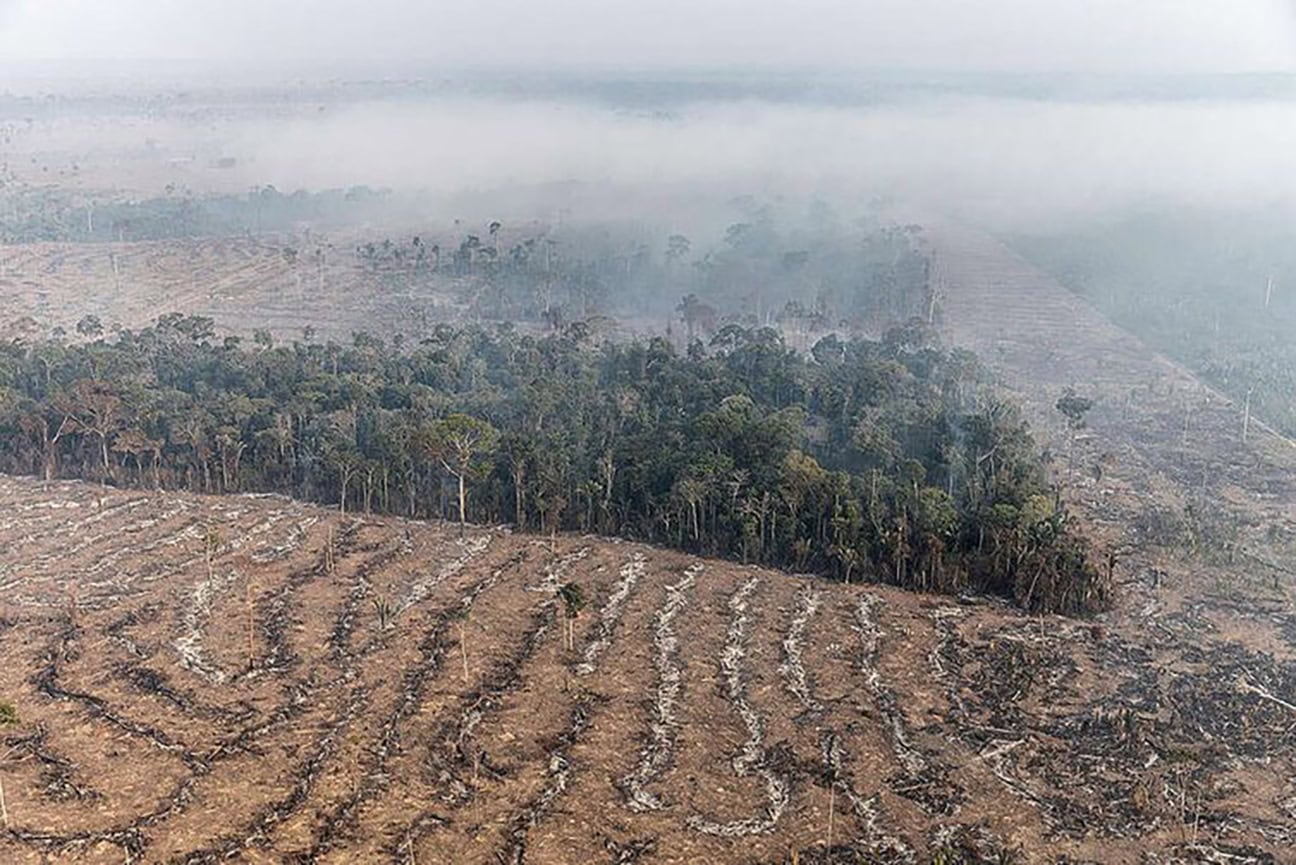
The dry season in the Brazilian Amazon is becoming more severe, and the forest’s temperature increased by 2 degrees between 1985 and 2020, according to a study led by scientists from the University of São Paulo.
The analysis reviewed 35 years of data on deforestation, temperature, and rainfall in the biome, allowing researchers to measure the impact of both deforestation and global greenhouse gas emissions on the forest. Deforestation accounts for 74.5 percent of the reduction in rainfall and 16.5 percent of the increase in the biome’s temperature during the dry season.
The researchers divided the biome into 29 analysis blocks, each covering an area of 300 kilometers. These blocks were designed to enable large-scale climate analyses, accounting for major rainfall events and broader climate systems. Despite this large-scale focus, the study achieved high spatial accuracy by using vegetation suppression mapping developed by the MapBiomas network, the researchers were able to work with data at a resolution of just 30 meters. By cross-referencing this information, they could track how changes in vegetation cover over the decades affected precipitation and temperature across different parts of the region.
In addition to helping understand the process, the research raised another red flag: maintaining current rates of local deforestation and global greenhouse gas emissions will increase climate extremes in the region, pushing it closer to a critical stress point. This could lead to increasingly severe impacts on the ecological balance as early as 2035. Currently, the average forest cover loss is 19 percent, but some areas have already reached up to 80 percent deforested surface.
“The Amazon is a very complex biome that receives moisture from the ocean and has a highly balanced hydrological cycle. It is already being impacted. We need to start reversing this process, and there is no room for additional stress factors on the biome, whether internal or external,” explained Professor Marco Franco of the Institute of Astronomy at USP, lead author of the article published in Nature magazine.
The researchers avoid using the term “point of no return” for the forest, as there is no consensus on its definition within the scientific community. However, they are unequivocal in stating that there is no safe margin for continued exploitation in the region. Large enterprises, such as mines and power plants, can further destabilize the environment and have the potential to affect vast areas.
Drought
According to Marco Franco, drought “is increasing by an average of 12 days every 10 years.” The effects are already being felt with a relatively small amount of vegetation loss – just a 10 percent reduction in the areas analyzed. The data show that suppression rates between 10 percent and 40 percent of native vegetation lead to a sharper decline in rainfall and further intensify local temperature increases.
Understanding this impact, the participants warn, highlights both the responsibility and the potential for cooperation between governments.
“We already knew that climate change was happening, based on previous studies. Now, we can measure it – and that allows us to sit down and talk with those responsible. It helps us understand our role – Brazil’s role – in relation to deforestation, and to engage with the rest of the world about the impact global greenhouse gas emissions have on the forest,” explained Professor Luiz Machado, who coordinated the study.
Still on the research findings, rainfall during the dry season has decreased by about 21 millimeters per year, with deforestation accounting for 15.8 mm of that reduction. The maximum temperature has risen by approximately 2 °C, with 16.5 percent of the increase attributed to forest loss and the remainder to global climate change.
This impact, however, varies by region. In areas of the eastern Amazon where vegetation cover remains close to its original state – with suppression below 10 percent – the effects of drought are much less severe. In these regions, the rise in temperature is attributed almost entirely to industrial emissions from external sources, particularly from countries in the Global North, such as the United States and China. In contrast, in southeastern parts of the biome – such as the Santarém region in the state of Pará – the impact of deforestation on temperature increase is more balanced, and the effects of drought are significantly more intense, Franco explained.
In the article, the researchers warn that if deforestation continues unchecked, the results suggest a further decline in total precipitation during the dry season and a greater increase in temperature.
Challenge
The group’s next challenge is to assess the potential impact on the forest under different scenarios up to the year 2100. One of their key contributions, beyond establishing the relationship among deforestation, precipitation, and rising temperatures, is making their parameters available to other research groups – enabling biologists, for example, to use the data to study the effects on species and more localized areas within the biome.
The Brazilian Amazon lost 14 percent of its native vegetation between 1985 and 2023, according to MapBiomas data, totaling 553,000 km² – an area equivalent to the territory of France. Pasture expansion was the main driver of this loss during that period. Although the deforested area has declined over the past two years, fires and the expansion of agricultural lands continue to threaten the region.