



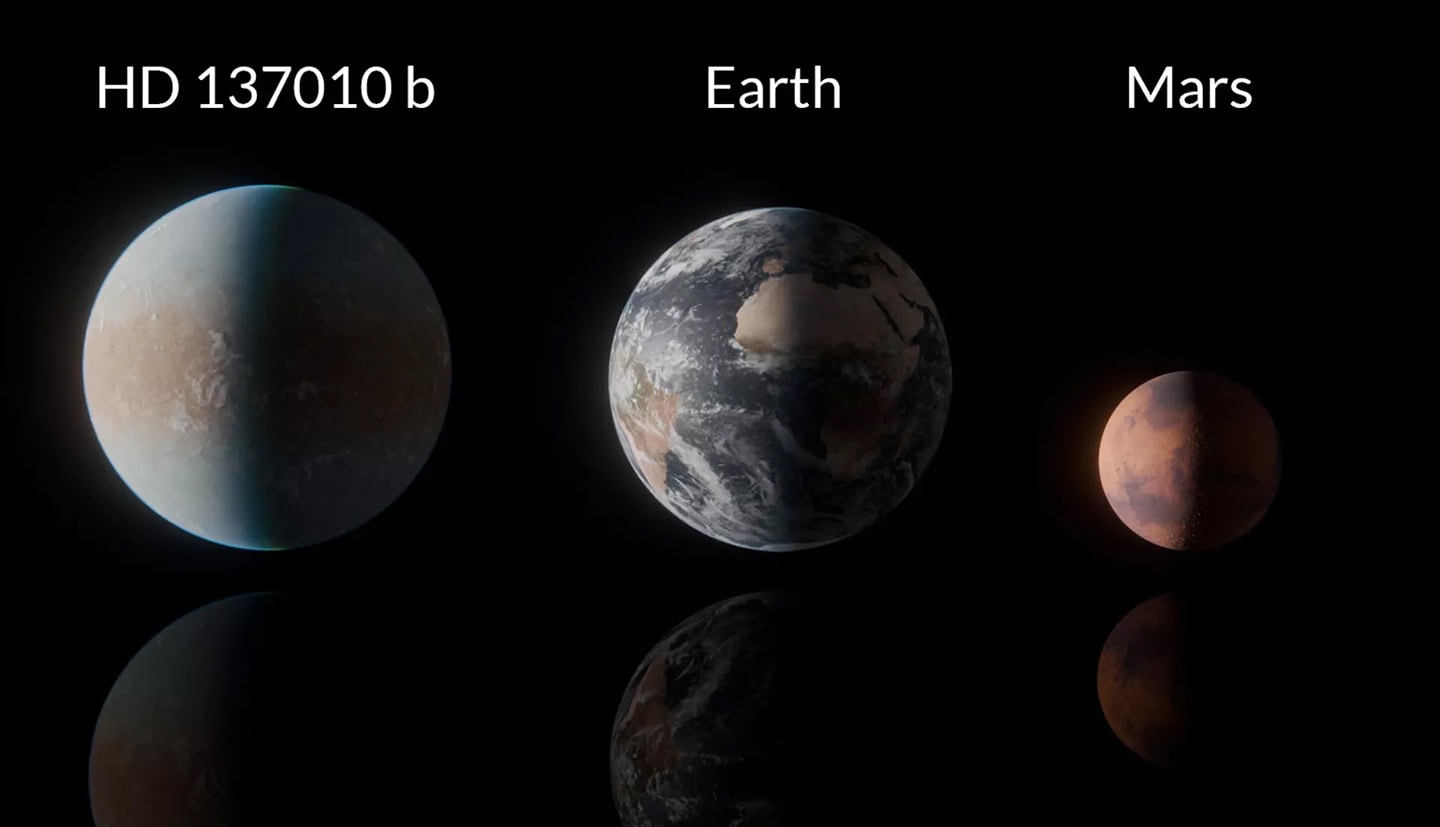
Astronomers have identified a possible planet with dimensions very similar to Earth orbiting a star about 150 light-years away in the Milky Way. Named HD 137010 b, the celestial body is approximately 6% larger than our planet and occupies a region considered strategic around its star, raising the hypothesis of conditions favorable to the existence of liquid water on its surface.
The discovery is the result of a joint effort by researchers from the University of Southern Queensland (UniSQ), Harvard University, and the University of Oxford. The study, published in the scientific journal Astrophysical Journal Letters , describes HD 137010 b as a planet situated in a kind of transition zone between Earth and Mars, both in terms of size and orbital position.
The planet orbits its star at a distance comparable to that of Mars from the Sun. This location places it within the so-called habitable zone, a concept used in astronomy to define the range in which, theoretically, water could exist in liquid form on the surface of a planet. For this reason, scientists consider the object a relevant candidate in the search for potentially habitable worlds outside the Solar System.
Lead author of the study, astronomer Alex Venner, assesses that the conditions of HD 137010 b offer a significant, albeit limited, probability of habitability. According to him, there is about a 50% chance that the planet has characteristics compatible with this scenario. “Really on the edge of what we consider possible in terms of potential habitability,” the researcher stated when describing the planet’s position and conditions.
Despite the enthusiasm generated by the discovery, HD 137010 b is not yet classified as a confirmed planet. In the scientific article, it appears as a “candidate,” since at least one more independent observation is needed to definitively prove its existence. This type of confirmation is essential to validate the data obtained so far.
Another factor that warrants caution is the estimated environment of the planet. Although the star HD 137010 is similar to the Sun, it is cooler and less bright. As a result, the planet would receive less than a third of the amount of light and heat that reaches Earth. Estimates indicate that the maximum surface temperature could reach around -68 °C, a value very close to the average temperature of Mars, which is approximately -65 °C.
Only with new observations will it be possible to confirm whether HD 137010 b is, in fact, a planet and to further analyze its physical characteristics. This additional data will also allow for a more precise assessment of whether this distant world could offer the minimum conditions for the presence of liquid water and, theoretically, some form of life.
Source: brasil247.com