



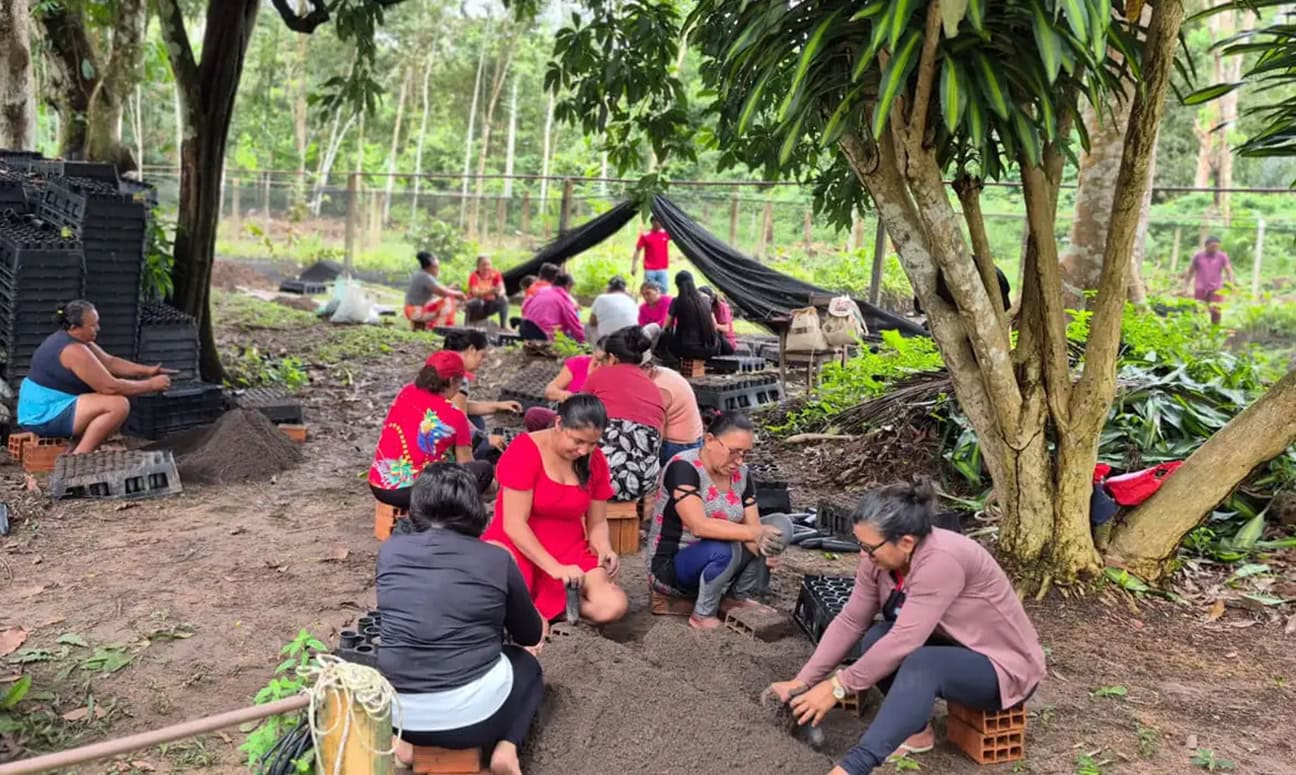
From a height of 30 to 50 meters, the andiroba tree drops ripe fruits to the ground. The impact splits the hard shell into four parts and scatters the seeds across the forest floor. That is where the work of Amélias da Amazônia begins – a group of riverside women who have been producing oils for medicinal and cosmetic purposes since 2016.
They live in the São Domingos community, within the Tapajós National Forest in western Pará state. All work is done by hand, respecting the rhythm of nature and local customs.
The first step is to collect the seeds, which are angular, rounded, coffee-colored, and have a cork-like texture. To arrive at the final product, it takes an average of three months – enough time for the stages of cleaning, cooking, drying, and cracking the seeds, followed by preparing the paste and decanting.
“We learned this technique for extracting oil from the andiroba tree from our grandparents and parents, who passed this culture and tradition down to us,” explained Marileide da Silva Monteiro, a riverside resident.
Monteiro said that most of the seeds were wasted. Some families used them to make medicine, but only in small quantities.
“One of my sisters had the idea to produce oil for sale, and we got together. It was a way to earn some extra income for the household and avoid having to work so hard in the fields under the sun,” she explained.
The venture brings together 16 people and is led by three sisters: Marileide, Marilene, and Marcilene. The women’s leading role in the project was one of the inspirations for the brand’s name.
In popular culture, “Amélia” has come to symbolize a submissive wife who endures everything without complaint – a reference to the 1942 Carnival march composed by Mário Lago and Ataulfo Alves.
The Amélias of the Amazon have redefined this stereotype. They faced skepticism from some men in the community and pressed ahead with their plan to start their own business, even if that meant taking on the heaviest tasks.
“We were used to working on the farm with our father – planting, making flour, tapping rubber trees. When the idea of starting a cosmetics business came up, we had to chop out tree stumps with an axe, clear the entire plot with a hoe, plant a vegetable garden, and build other structures. It was a lot of work,” said Marilene Dias da Silva.
Today, in addition to andiroba and copaiba oils, they produce soaps, candles, incense, creams, and insect repellents – all based on raw materials from the Amazon.
“With the money, I can now pay for my son’s school. I can also buy him better shoes. I can’t say it covers everything, but it’s a start, and the earnings help the family make ends meet,” Marileide Monteiro pointed out.
A new generation of the family is being prepared to take over the business, also playing a leading role. This is the case of Silvia Gabrielly, 23, Marileide’s daughter. She divides her time between her job as an environmental agent at the Chico Mendes Institute for Biodiversity Conservation (ICMBio) and managing the Amélias’ social media accounts.
Gabrielly’s plan is to invest in her education and bring new knowledge and technology to the community.
“I’ve already taken several courses in environmental studies and tourism. Now I’m pursuing a bachelor’s degree in environmental technology. I want to understand more about plantations, product production, and business management. We also need more knowledge to manage and promote our work,” the young woman stated.
Biocosmetics
The oils produced by the Amélias are not limited to the São Domingos community. They also serve as raw materials for Mahá Biocosméticos. The business was conceived by pharmacists Melissa Karen Lage and Bruna de Souza while they were undergraduate students at the Federal University of Western Pará (UFOPA).
They specialized in hair care products such as shampoos, conditioners, and nourishing masks. The idea stemmed from a personal need on Lage’s part, who identified a gap in the market.
“Back then, there were almost no options for curly hair, especially products that provided long-lasting results and actually cared for the hair. I started experimenting with aloe vera oil until my mentors suggested ingredients from the Amazon. So we decided to use oils and butters from right here in the region,” the pharmacist explained.
Aloe vera – which originated in Africa and the Arab world and is produced mainly in Brazil’s Southeast – was phased out, and oils from andiroba and Brazil nut, species native to the Amazon, were introduced. To achieve this, it was essential to establish partnerships with traditional communities.
We always wanted to do something that would benefit the entire region. When people buy our products, they are strengthening local supply chains,” Lage noted.
According to her, one of the business’s priorities from the very beginning has been to support local efforts to preserve the forest. For this reason, the Amélias team visited Mahá’s laboratories, while Lage and Souza provided training on how to repurpose andiroba waste.
To make local economic integration even more comprehensive, other key ingredients for cosmetics would need to be produced in the region. However, some raw materials – such as menthol, glycerin, and essential oils – must be purchased from companies in São Paulo or Rio de Janeiro. The same applies to biodegradable packaging.
Despite logistical challenges, Mahá is expanding and has managed to sell products throughout Brazil. The plan now is to increase sales volume. A partnership has been formed with Bemol, a retail group based in Manaus, Amazonas state, and production has been outsourced: it is now handled by Ekilibre da Amazônia, a factory in Alter do Chão, also in Pará.
The pharmacists have been able to devote more time to the creative side of their work. Using various natural elements and chemical ingredients, test tubes, and electronic equipment, they develop new formulas.
“Some people think that products from the Amazon are still just handmade. These things have value, but we also do science. We are at the university and develop our products through rigorous scientific methods. At the same time, we value the community’s traditions,” Lage stressed.
Ancestry and innovation
Mahá’s laboratory is located at Oka Hub, a bioeconomy business incubator in Belterra, in Pará. Conceived by Colabora Lab in partnership with the Brazilian Micro and Small Business Support Service (Sebrae), the initiative aims to provide small businesses with infrastructure and training, as well as help them establish contacts with other companies.
There is a network that connects these entrepreneurs with institutions such as the Brazilian Industrial Research and Innovation Company (EMBRAPII) and the Federal University of Western Pará (UFOPA), as well as with traditional communities.
“Indigenous peoples, quilombolas, and riverine communities living in the Amazon have accumulated knowledge of inestimable value, which now takes on a new dimension with the bioeconomy. This knowledge concerns the sustainable use of the region’s resources, which, although abundant, are not inexhaustible,” emphasized Bruno Quick, technical director of Sebrae Nacional.
According to the organizers, 11 businesses are currently supported at Oka Hub, a space that, according to its official motto, is “where science meets the forest and ancestry becomes innovation.”
“By supporting these innovation environments, we are providing the necessary means for technology to serve as a tool to scale up and ensure the sustainability of forest-based knowledge, generating jobs and skilled income in the region itself,” Quick added.
Source: Agência Brasil