



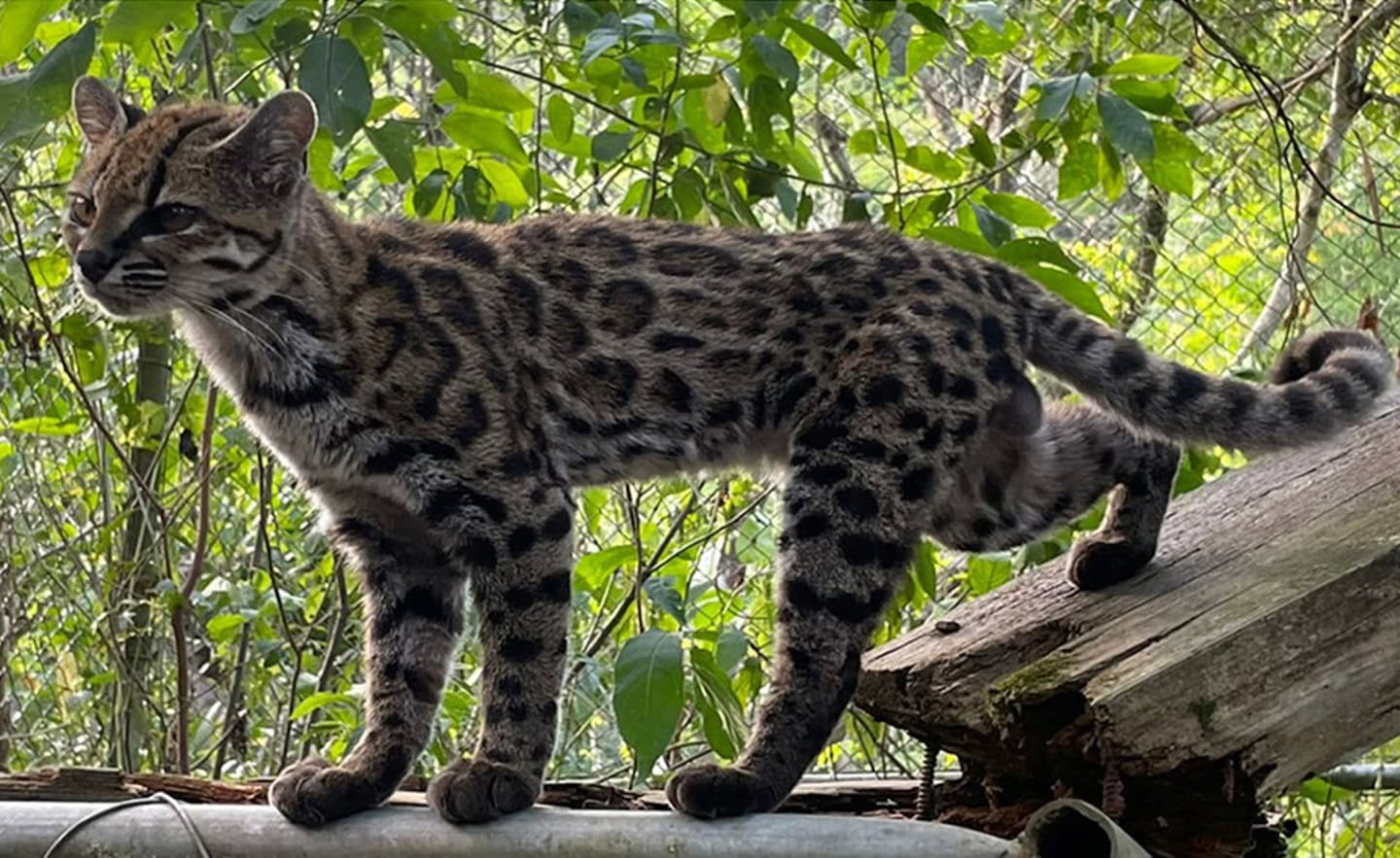
A new species of feline, named Leopardus tilcayo, has been identified in the mountain forests of Bolivia, in a region known as Nor Yungas.
The discovery was made by researchers led by Eduardo Eizirik, a professor at the School of Health and Life Sciences at the Pontifical Catholic University of Rio Grande do Sul (PUCRS).
The scientific description of a new feline species is the first in over a century. The study, published in the scientific journal Current Biology, was based on the genomic analysis of an animal known by the nickname “Tigrino.”
The male was found as a cub in 2016 by a resident of the Nor Yungas region in Bolivia. The specimen was later taken to the La Senda Verde animal sanctuary, where he has remained ever since.
Genomic results were published on September 17 and show that the animal did not belong to the species previously imagined (Leopardus tigrinus), but was part of an evolutionarily distinct lineage that had not yet been recognized by science.
“This study highlights just how much there is still to discover about the planet’s biodiversity. Even among charismatic and well-known animals such as felines, species can remain unknown for centuries. Discovering and understanding these species is vital so that we also know how to protect them,” Eizirik noted.
According to the university, the article Phylogenomics and Museomics Reveal Five Distinct Species of Tiger Cats in South America also provided new insights into the diversity of wildcats known as “tiger cats.”
The research found that the group, which until recently was considered a single species, is in fact composed of five distinct species.
This conclusion was reached thanks to the sequencing and analysis of complete genomes from 38 individuals from different regions of South America. Among the samples analyzed were eight historical specimens housed in museums in Europe and the US.
The wild cats analyzed, Eizirik said, can be classified as cryptic species – animals that look very similar but exhibit genetic differences and independent evolutionary trajectories.
“This visual similarity led to different species being confused and classified as a single species for a long time,” he says.
The research brought together scientists from PUCRS and partner institutions in Brazil, Bolivia, Peru, Belgium, Colombia, the US, and the UK.
Source: Agência Brasil