



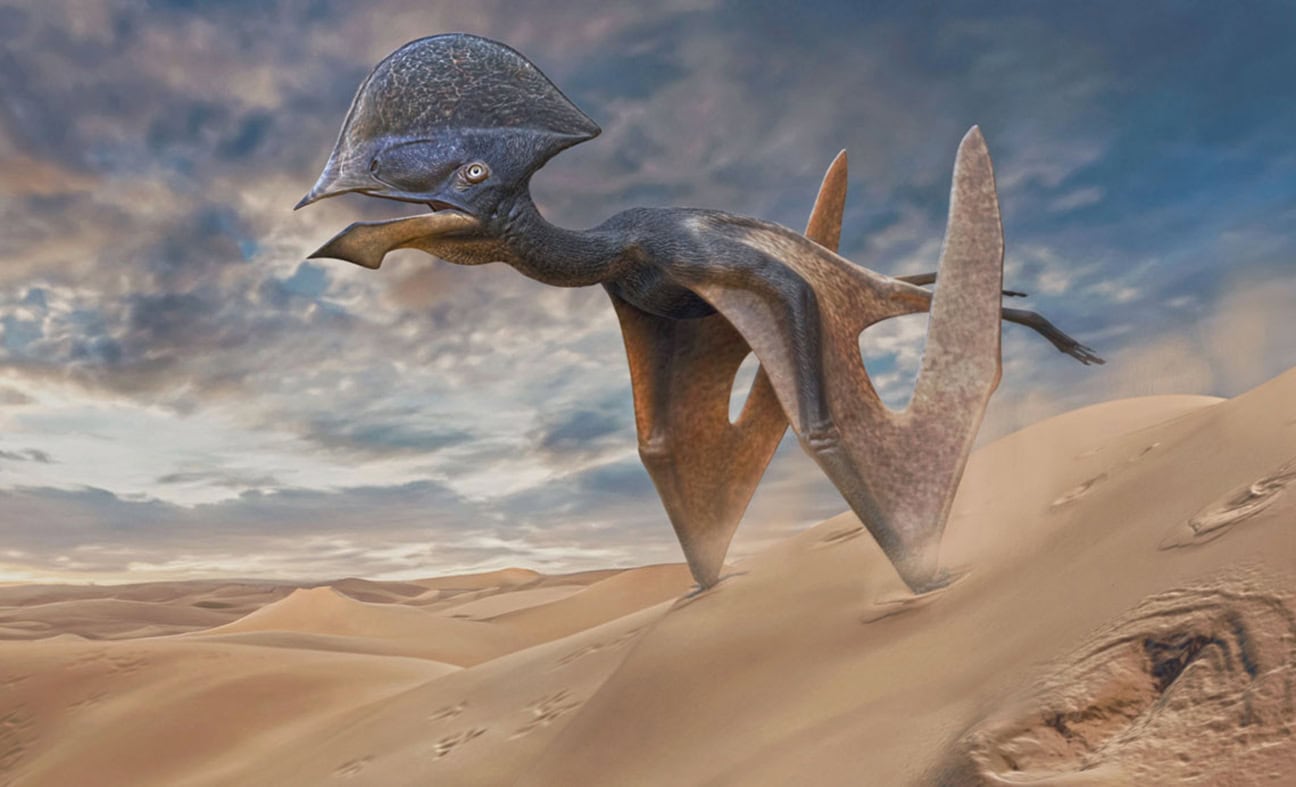
A new fossilization mechanism capable of preserving soft tissues and even steroids – extremely fragile organic molecules – in a 113-million-year-old pterosaur from the Cretaceous period, the age of the dinosaurs, has been identified by researchers from Brazil, Australia, Germany, and the United States. The fossil of the flying reptile was found in the Romualdo Formation of the Araripe Basin, in the state of Ceará, northeastern Brazil.
The groundbreaking research, based on advanced geochemical, microscopic, and 3D tomographic analyses, reveals that sulfur-oxidizing bacteria played a decisive role in the rapid mineralization of the fossil, ensuring its exceptional three-dimensional preservation.
The study brought together experts from 15 international institutions and details analyses using tomography, isotopic geochemistry, electron microscopy, and mass spectrometry.
“The preservation of this pterosaur is extraordinary. We’re talking about tissues and molecules that, under normal conditions, would disappear within a few days. The fact that we have access to this level of detail more than 100 million years later shows just how important the Araripe Basin is as one of the most significant fossil sites on the planet,” says paleontologist Alexander Kellner of the National Museum at the Federal University of Rio de Janeiro (UFRJ), one of the study’s authors.
Kliti Grice, John Curtin Distinguished Professor and founding director of the Western Australia Centre for Organic and Isotope Geochemistry at Curtin University, stated the findings open a new window into fossil formation.
“This fossil is a true time capsule – not only is it beautifully preserved, but for the first time, we’ve detected traces of steroids in a pterosaur, providing further evidence that these creatures likely fed on fish or squid,” said Grici.
The research suggests that this is a “domino effect” process in which the animal’s initial decomposition creates chemical microenvironments that support specific microorganisms. These microbes trigger a sequence of mineral precipitation events (sulfates, phosphates, and multiple phases of carbonate), which seal the fossil before its tissues and biomolecules degrade.
“This discovery changes our understanding of how exceptional fossils form. We have shown that microbes can create highly efficient microenvironments that preserve tissues and molecules that would normally disappear within days. The study highlights that the Araripe Basin continues to reveal extraordinary secrets. This work reinforces the scientific and heritage importance of this Brazilian region,” stated Professor Antônio Álamo Feitosa Saraiva of the Regional University of Cariri.
Pterosaurs were flying reptiles that lived alongside dinosaurs and were the first vertebrates to master powered flight, with some species reaching gigantic wingspans of over 10 meters. “This specimen represents an individual from the group known as Anhangueridae and had a wingspan of nearly 8 meters,” noted Professor Renan Bantim, curator of the Plácido Cidade Nuvens Museum, where the specimen is housed.
Beyond the scientific aspect, we should celebrate the long-standing partnership between the National Museum/UFRJ and the Regional University of Cariri (URCA), which has yielded spectacular discoveries. “Now, through the National Institute of Science, Technology, and Innovation (INCT Paleovert), we have the opportunity to establish partnerships like this one with Curtin University in Australia, and to push the frontiers of knowledge in the study of organisms that inhabited our planet millions of years ago,” Kellner emphasized.
Source: Agência Brasil