



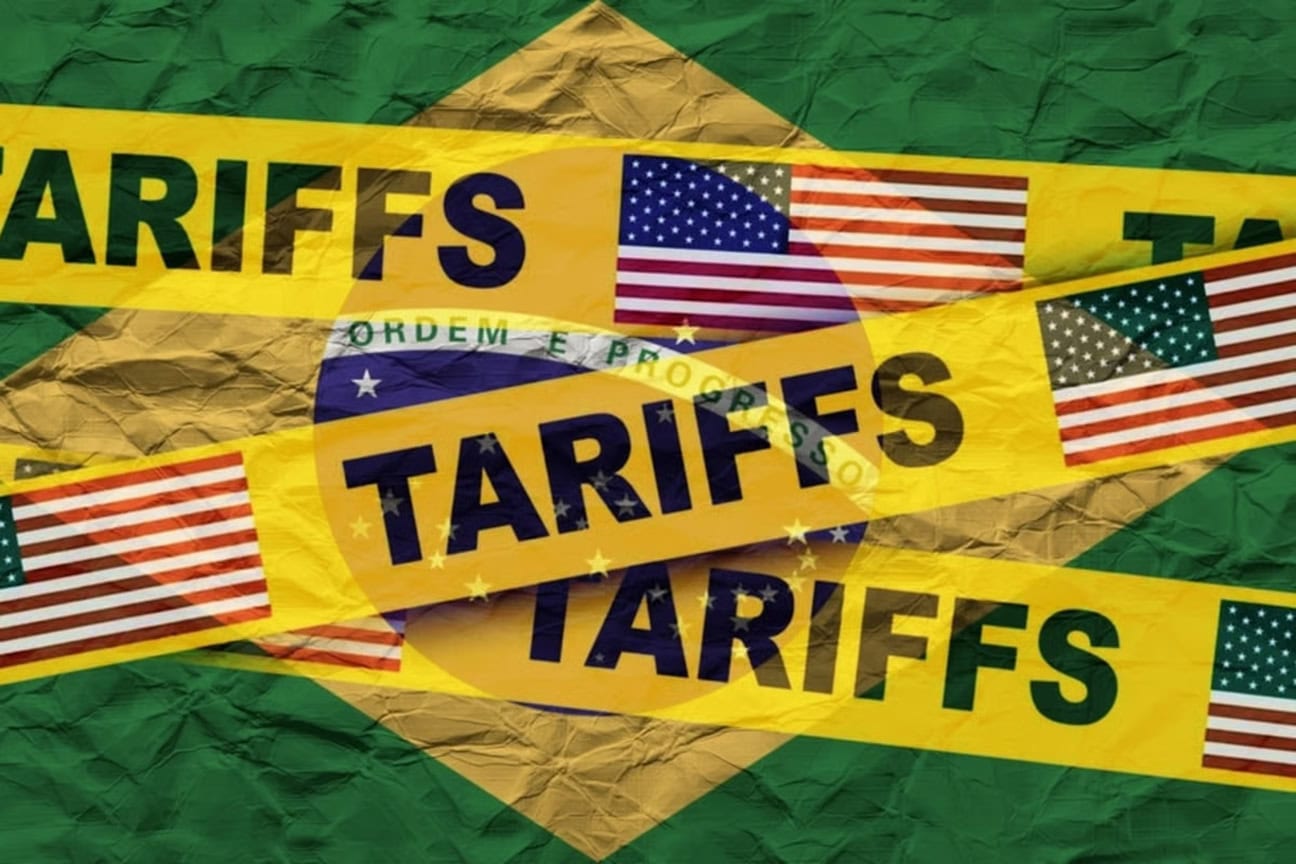
The United States announced on Thursday (Jul. 23) the imposition of a new 12.5 percent tariff on Brazilian products, alleging that Brazil has not adopted effective mechanisms to prevent the import of goods produced using forced labor. The measure took effect on Friday (24).
The new tariff replaces the temporary 10 percent across-the-board rate that had been in effect since February and comes in addition to the 25 percent surcharge on Brazilian products that took effect on July 22. As a result, some of Brazil’s exports to the US market may be subject to tariffs of up to 37.5 percent.
The decision was made by the Office of the United States Trade Representative (USTR) following an investigation conducted under Section 301 of the Trade Act of 1974.
Rationale
According to the US government, Brazil is among 54 countries that neither prohibit nor effectively monitor the import of products manufactured using forced labor.
In the USTR’s assessment, this failure creates an unfair competitive advantage by allowing the circulation of goods produced with forced labor at lower costs.
US Trade Representative Jamieson Greer stated that the practice harms US companies and workers.
“The failure of our trading partners to address the importation of goods made with forced labor is unacceptable. This forces American workers to compete on an uneven playing field,” Greer said in a statement.
Products
The report states that, between 2021 and 2025, Brazil imported products linked to forced labor in five sectors: aluminum; cotton; electronics; lithium batteries; tobacco.
According to the USTR, these products could enter the Brazilian market at artificially low prices and subsequently affect the competitiveness of domestic exports.
The document also notes that, although Brazil participates in international agreements to combat forced labor and maintains the so-called “Dirty List of Slave Labor,” the United States considers the country’s mechanisms insufficient to prevent the importation of these goods.
Countries
The investigation covered 60 US trading partners.
In addition to Brazil, 53 other countries were subject to the 12.5 percent surcharge, including China, Argentina, Australia, Japan, India, the United Kingdom, and South Africa.
Brazilian reaction
In a statement, the Brazilian government criticized the new 12.5 percent tariff imposed by the United States and described the measure as “arbitrary” and “unjustified.” According to the Brazilian government’s Secretariat for Social Communication (Secom), Brazil provided the US government with information on its legislation and enforcement mechanisms to prevent the importation of products associated with forced labor, while also highlighting the country’s international recognition for combating forced labor.
The statement also notes that the government intends to invoke the mechanisms provided for under the Reciprocity Act and bring the case before the World Trade Organization’s (WTO) dispute settlement system.
While considering a diplomatic response, Brazil is maintaining measures to support exporters affected by US tariffs through the “Plano Brasil Soberano” (Sovereign Brazil Plan) initiative, which provides credit lines and incentives to access new markets.
Source: Agência Brasil