



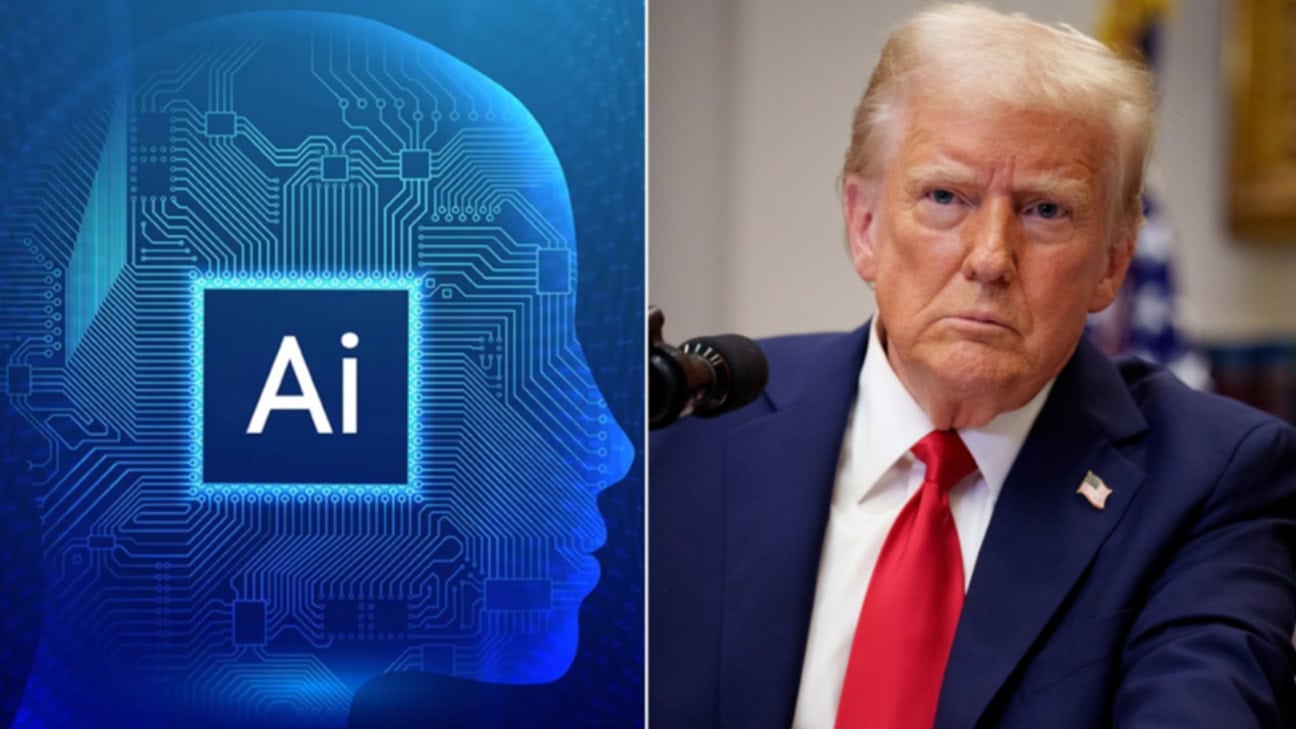
The announcement by the US government and major AI companies to establish voluntary self-regulation and safety controls for the development of the technology represents a “free pass” for the industry, potentially posing risks to public health and democracy in various countries.
This is the assessment of sociologist Sérgio Amadeu, a professor at the Federal University of ABC (UFABC) and the author of works on digital technologies.
“What Trump did was to completely and irresponsibly hand over democratic control of AI development to the very corporations that develop it. This is a gigantic risk,” Amadeu said.
The agreement, signed Tuesday (Sep. 29) at the White House with OpenAI, Meta, Anthropic, Google, Nvidia, and X (formerly Twitter), includes the implementation of “internal controls” to monitor AI models. The controls are intended to “ensure that their models do not intrude upon or access technical systems in unintended ways.”
“This is already being done. The entire AI training process requires robust oversight, and internal monitoring is already in place. None of this adds anything significant to the regulation and control of the improper use and development of machine learning and deep learning,” Amadeu added.
Regarding the proposal for independent external audits of AI companies, the UFABC professor argues that the audits would be paid for by the companies themselves.
“To what extent will this external auditor, paid by the company itself, offer criticism and suggestions that could cause discontent among the companies’ boards of shareholders?” the professor asked.
Fragile benefits
Ettore Arpini, an AI governance expert and founder of Plures – an organization that supports the training of professionals in the AI field – told Agência Brasil that the voluntary agreement among AI companies could yield real benefits.
However, he warns that the commitment could be abandoned once the safeguards become commercially detrimental.
Arpini cites the example of the Amazon Soy Moratorium, a voluntary agreement involving companies in the sector that committed to refraining from planting soybeans in the Amazon and preventing deforestation of the biome.
“This worked for 20 years on a voluntary basis, until the political and economic environment changed and the participating companies withdrew from the agreement, causing the moratorium to fail. What happens if a company fails an audit or withdraws from the pact?” he asked.
Public health
Sociologist Sérgio Amadeu points out that AI poses environmental risks due to its high energy and water consumption, privacy risks due to its capacity for mass surveillance of populations, as well as risks to democracy and public health.
He explains that various research projects conducted in the pharmaceutical industry in partnership with big tech companies using AI models may pose risks to public health and therefore require government regulation.
“We know that when the use of AI is controlled solely by investors, it poses a huge risk to experiments,” he commented.
Among the risks, the expert cites the possibility that the use of AI could lead people to self-medicate or even use the technology to diagnose themselves.
Social concerns
The Trump administration has refused to impose limits on AI development, despite requests from the industry itself and pressure from civil society in the United States.
An opinion poll conducted by Ipsos and Reuters found that 73 percent of Americans believe AI companies are not taking sufficient measures to prevent the technology from harming society, while 39 percent think that AI is having a negative impact on society.
One of the identified risks is that these systems could make cyberattacks easier to carry out by hacking into the systems of other companies and institutions. Other risks associated with AI include its impact on the labor market and the “malicious” use of the technology by criminals to conduct cyber scams.
Democracy
AI can also be used to influence public opinion by manipulating information circulating on social media, according to the International AI Safety Report 2026, prepared by 100 experts from more than 30 countries.
“Several laboratory studies have shown that interaction with AI systems can lead to measurable changes in people’s beliefs,” the report notes.
Another risk highlighted in the report relates to the development of chemical and biological weapons.
“General-purpose AI systems can provide information on the development of biological and chemical weapons, including details on pathogens and specialized laboratory instructions,” the international report states.
Source: Agência Brasil