



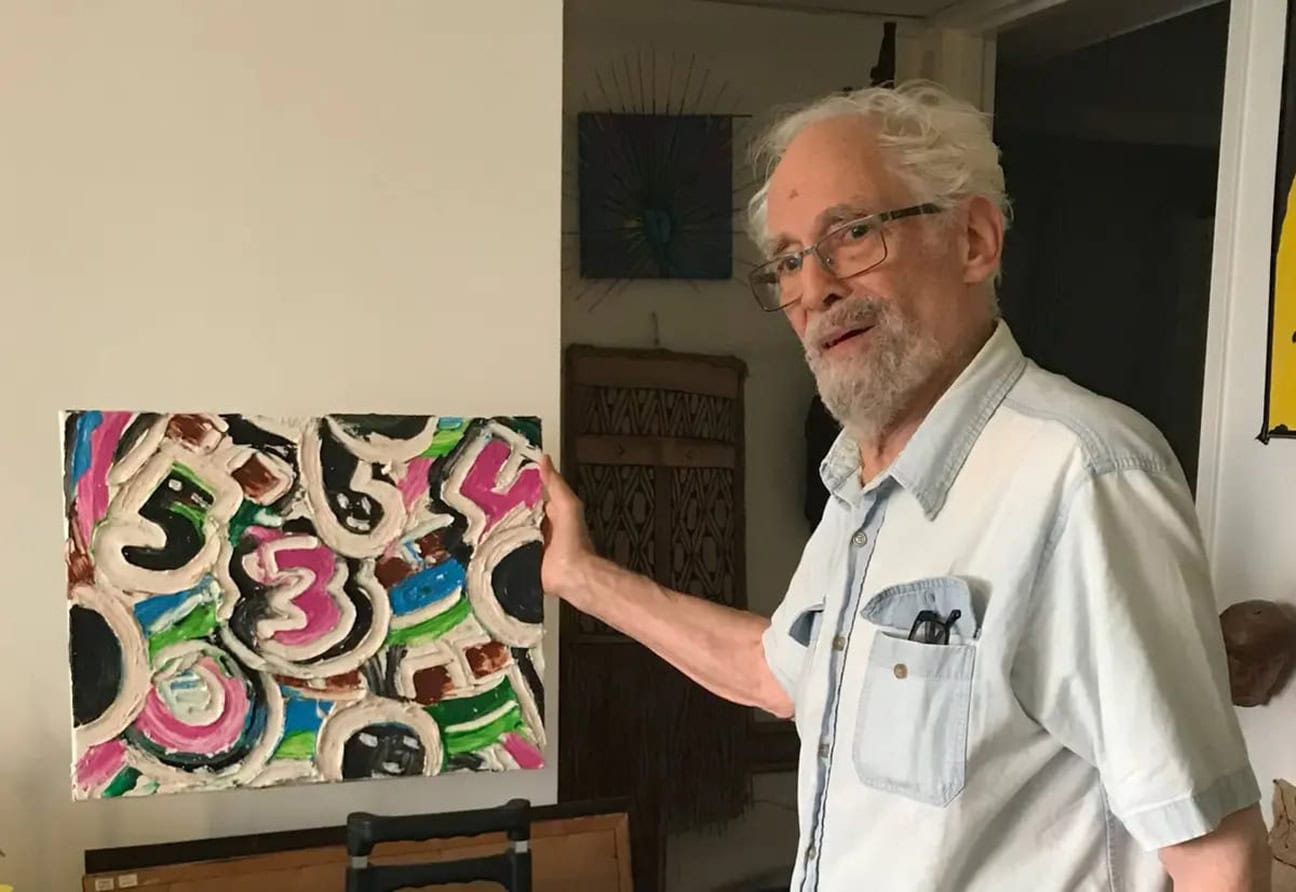
During a phone conversation with Peter Selz (1919-2019), he later described things about Jay Milder that had happened long before they became friends.[1] Selz remarked that Thomas Hess (1920-1978) had described Jay Milder (1934-2026) as one of the six original proponents of Figurative Expressionism: when abstract expressionism “was going out, they were coming in.” Selz’s interview is published on the Urban Visionary catalog curator Martha Henry.[2]
 Born in 1934 in Omaha, Nebraska, Jay Milder is a widely recognized, controversial artist–philosopher who incorporated Kaballah, numerology, and other religious and mystical belief systems into his works. Professor Melissa Rachleff refers to Milder as one of the most important contemporary artists in her book Inventing Downtown: Artist-Run Galleries in New York City, 1952-1965, and this sentiment is echoed by the writer Judith Stein in Eye of the Sixties: Richard Bellamy and the Transformation of Modern Art, as well as by the curator and critic, April Kingsley, in her book, Emotional Impact: American Figurative Expressionism.[3]
During high school, Milder frequented jazz clubs in the African American section of Omaha to listen to live performances by Sarah Vaughan, Ella Fitzgerald, and other renowned artists. In the early 1950s, he studied in Paris with Ossip Zadkine and André Lhote, and Ed Clark was his mentor. He left Paris to stay in North Africa from 1953 to 1954, where he spent two summers living in the Arab section of Morocco. Upon his return to America in 1955, he spent
one semester at the Chicago Art Institute. During the next summer, he traveled to Mexico to study the pyramids. Once in Mexico City, he had to leave the day after he arrived because of an earthquake. He boarded a bus to Puebla for safety, and stayed there with local Mexican artists and had a small studio in the Barrio del Artistes in Puebla where he painted. He exhibited his art in Puebla at the end of 1955 and was awarded the Certificate of Mexican Artist by the Governor of the State.
Later, from Vera Cruz, he hitch-hiked across the Gulf of Mexico in a fishing boat, disembarking in Progresso in Yucatan. Subsequently, he boarded a bus to Merida, the capital of Yucatan. He was interested in the people, mostly Mayans, who did not speak much Spanish. The structure and geometry of the pyramids fascinated Jay, as he was developing his visual concepts based on geomancy, which necessitates a deep understanding of earth science. Finally, he left Yucatan and traveled to Campeche City, which had been founded in 1540 on the shore of the Gulf of Mexico. In Campeche, Jay spent all his time drawing. He eventually returned to Puebla, where there was a widespread outbreak of the Asian flu. Thus, Jay was forced to return to Mexico City, where he quickly boarded a bus to the US because of the 1955 pandemic.
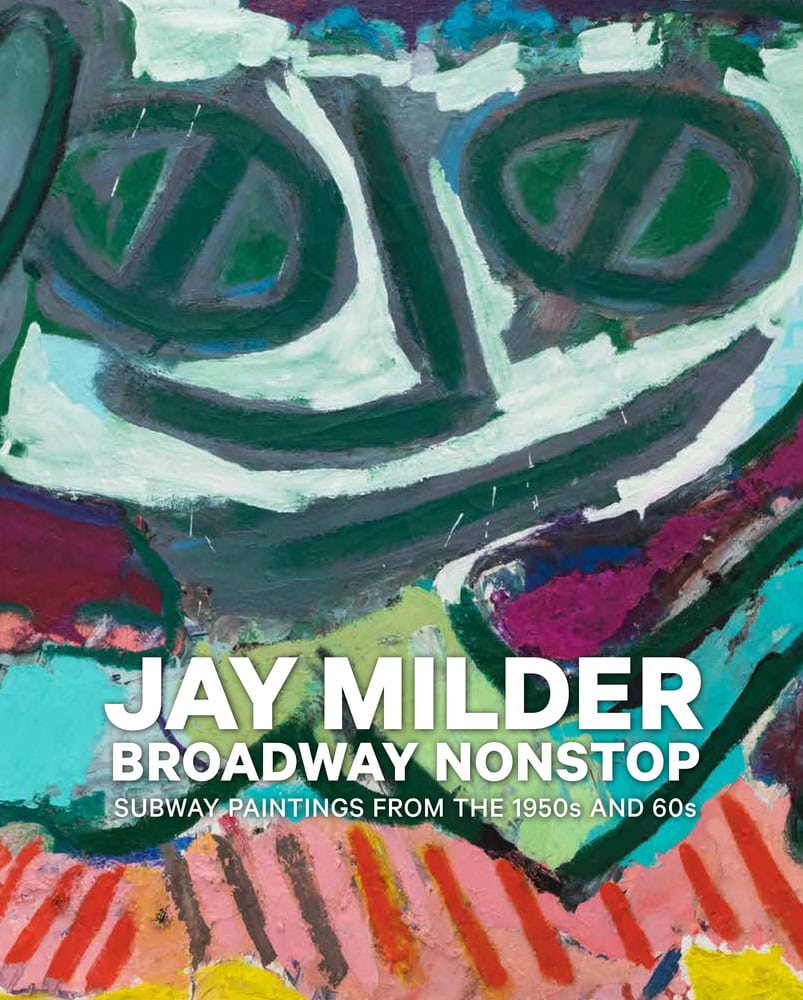
In 1958, Jay Milder was in Provincetown, MA, where he studied with Hans Hoffman and exhibited in the Sun Gallery. Back in New York City, he connected with Bob Thompson and Red Grooms to start the City Gallery. They started the Delancey Street Museum one year later. (This period was later documented by the art historian and curator Melissa Rachleff in the above-mentioned exhibition catalog, Inventing Downtown) In the ‘60s, Thompson and Milder shared an abandoned apartment in 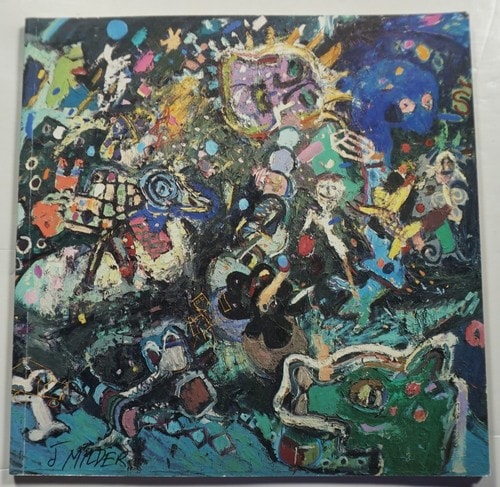 New York, where they met Allan Kaprow (1927-2006), a performance artist, who helped to develop the “Environment and “Happening” during the 50s and 60s in NYC. Jay and Bob Thompson painted the background for Kaprow’s first happening, which happened at the Reuben Gallery in October 1959.[4]
Milder’s first solo exhibition was at the Alan Stone Gallery, New York City, in 1960. A few years later, Lester Johnson introduced Milder to the most important Expressionist Art dealer in the United States, Martha Jackson (1907-1069), a gallery owner who gave Milder his second solo exhibition, in 1964. Jackson was an important catalyst who propelled Jay into the Art world internationally.
In the many articles on philosophy and metaphysics he’s been writing since the 1970s (including an unpublished book called The Genesis of Western Alienation), Milder has collected the ideas that comprise the inspiration for his paintings, which have inspired many critics, artists, and writers. His ideology is concerned with life, socio-political injustice, native peoples, the Jews, the Africans, the Arabs, and the Hispanic peoples.
It can be argued that the interest in mysticism is ingrained in the family ancestry: Milder’s great-great-grandfather was Nachman of Breslov (1772–1810), who lived in Ukraine, Russia. Rabbi Nachman was the great-grandson of Ben Eliezer, Baal Shem Tov (1698–1760), the founding father of the Hasidic Sect in the eighteenth century. Nachman had an important influence on the writings of Franz Kafka. Rabbi Nachman’s religious philosophy revolved around closeness to God and speaking to God through normal conversation “…as you would speak with a best friend.” As the founder of the Breslov Hasidic movement, he attracted thousands of followers with his religious philosophy.
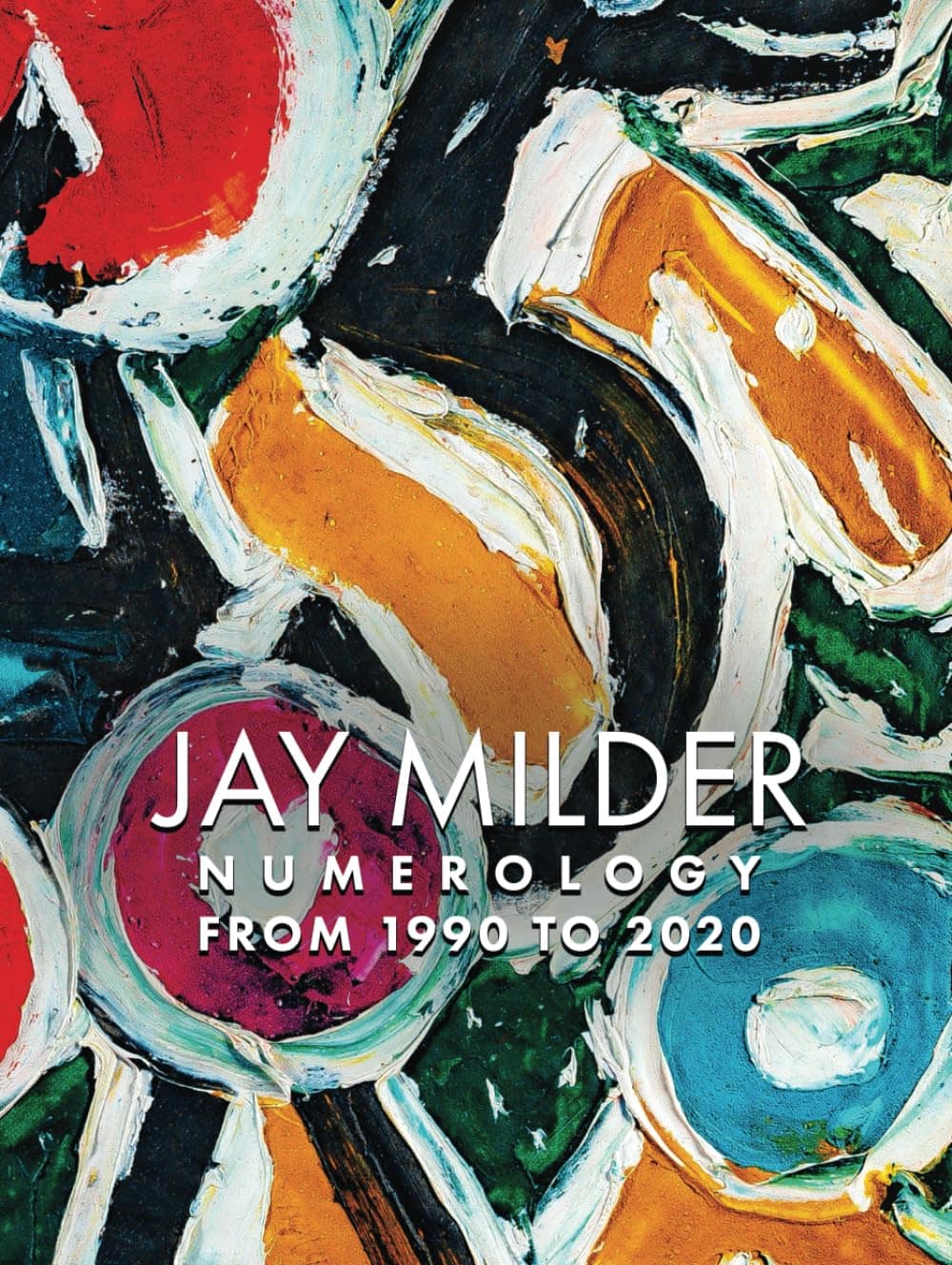
The Cuban scholar Yana Elsa Brugal introduced Milder to Dr. Miguel Hernández, Director of the Museo Casa de México, Benito Juárez, in Havana, 2019, one of the most important museums in the Spanish-speaking countries. Dr. Hernandez invited Milder for a solo exhibition in 2020, which was eventually postponed to 2025 due to the COVID-19 pandemic. But the solo show only happened this year, resulting in the catalog with the same name of his most recent painting series, “Numerology.” In it, Milder traces a deep spiritual connection to the beginning of his artistic life in Puebla, México, in 1955, when he started studying the structure of the pyramids such as the Palenque, the Chiche Itza, and the Ushmal, in Yucatan.
In 1999, Milder had his first exhibition in Brazil at the National Museum, in Brasília. Dinah Papi de Guimaraens, Ph.D., curated his second exhibition in Brazil at the Museum of Modern Art, MAM, Rio de Janeiro. This exhibition was a success, and it was extended for more than four months. A third exhibition was at the Museum of Modern Art, Salvador, Bahia. Milder’s first three exhibitions were followed by others in Sāo Paulo, auctions, a lecture at the Fluminense Federal University, and TV presentations in Rio de Janeiro and São Paulo. In 2009, after 15 years of exhibiting his works in Brazil, Jay Milder was honored as a Shaman of the Guarani people as well as was awarded the title of Cultural Ambassador by the Brazilian government between Brazil and the USA.
Milder was always a Figurative Expressionist, where he states his beliefs in the dialect perspective. He is considered one of the top three Figurative Expressionists with George McNeil and Robert Beauchamp, as April Kingsley stated, Emotional Impact, p. 04. Bob Thompson and Gandy Brodie, in Provincetown in the early years, were a big stimulating impetus for their early work. Milder was drawn to Cabala, which holds that Scripture can be interpreted in thousands of ways, as in Sufism and other Eastern philosophies. Eric Firestone Gallery, New York City, represents him.
[1] I met Peter Selz when he went to meet Jay in Easton, PA, to interview him for the curator Dinah Guimaraens, for MOMA in Rio de Janeiro, Brazil.
[2] Selz, Peter Jay Milder: Urban Visionary, catalog Urban Visionary Curator, Martha Henry 1991 p.4 – 7
[3] Rachleff, Melissa. Inventing Downtown: Artist-Run Galleries in New York City, 1952-1965. Prestel Publishing, 2017; Stein, Judith. Eye of the Sixties: Richard Bellamy and the Transformation of Modern Art. Farrar, Straus and Giroux, 2016, p.103; Kingsley, April Emotional Impact: American Figurative Expressionism. Michigan State University Press, 2013 p.4
[4] Glimcher, Mildred L. Happenings, New York, 1958-1963 – Opening the Space Between Art and Life, The Monacelli Press, 2012 New York, pp. 35–39
LIZA RENIA PAPI
Author, Curator, Director, Brazilian Library of New York, Prof. St. John’s University.